

Embracing Authenticity by Finding the Joy in Saying No
Discover why even the best of us struggle to say no.

Have you ever found yourself nodding in agreement when you actually wanted to say no? Or felt stretched thin with the multitude of commitments you accepted responsibility for, that you lost sight of your own needs? These subtle acts of self-silencing are signatures of a habit that many of us share: people-pleasing.

What happened to us?
The urge to please others is an instinct nurtured by societal expectations that paint compliance as a virtue. We were taught, as children, that being passive and respectful is more important than our true desires and capabilities. Or it could be a result of unmet needs of recognition and validation from our childhood, so we used these as guiding forces in the pursuit of approval and acceptance. These fragments of our past etched onto our identity, forming the foundation of our people-pleasing tendencies, as we seek to mend old wounds through others’ approval.
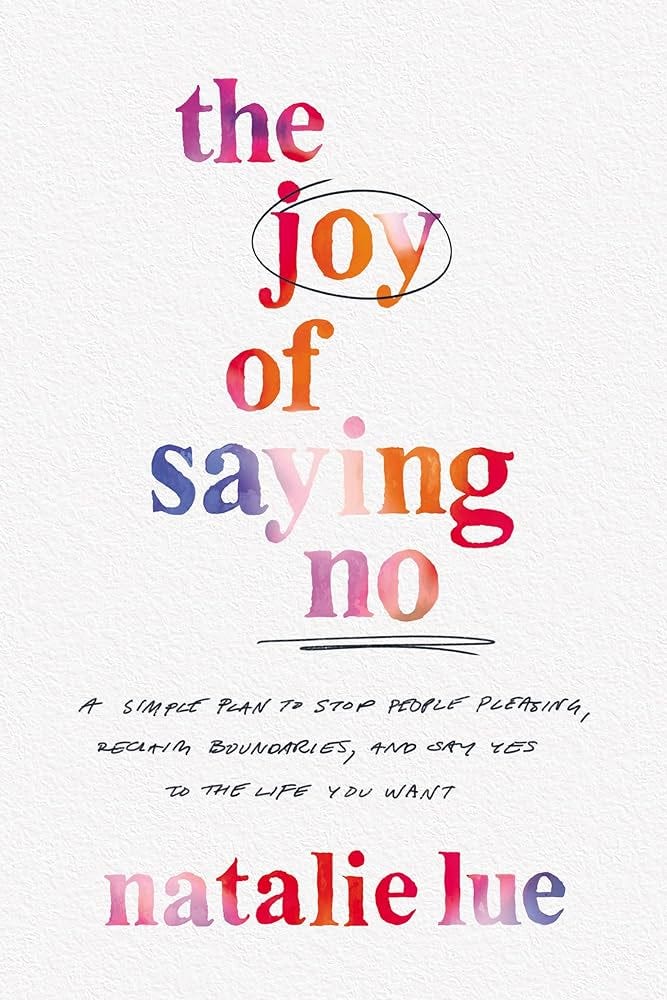
The Joy of Saying No by Natalie Lue
The reflection and insights in this article were kindled by the profound insights shared by Natalie Lue in her book The Joy of Saying No (2022). Natalie, a distinguished writer and podcaster known for her expertise in relationships and boundaries, has illuminated the path for people to free themselves from emotional baggage and discover their authentic self and happiness through her website BaggageReclaim.com since 2005.

We feel guilty saying no to people
Let's picture a common scenario: You're at work, and your colleague asks you to take on an additional project. Your plate is full, but you hesitate to say no because you don't want to disappoint them or create conflict. You end up saying yes, even though it adds more stress to your busy schedule. You just agreed to something you didn't want to do.
Why does this happen, even to the best of us?
Feelings of guilt or obligation can compel someone to take on more than they can handle. Natalie states that people-pleasers do so to try and influence other people’s feelings and behavior either to gain attention, affection, approval, love, validation, or to avoid conflict, criticism, stress, rejection, disappointment, loss, or abandonment. We internalized a strategy to be agreeable to make peace, but in doing so, we find ourselves inundated and short-changed. We were never truly happy pleasing others; yet we repeat the cycle every time because of unresolved issues.
These patterns stem from emotional baggage we’ve carried from the past.
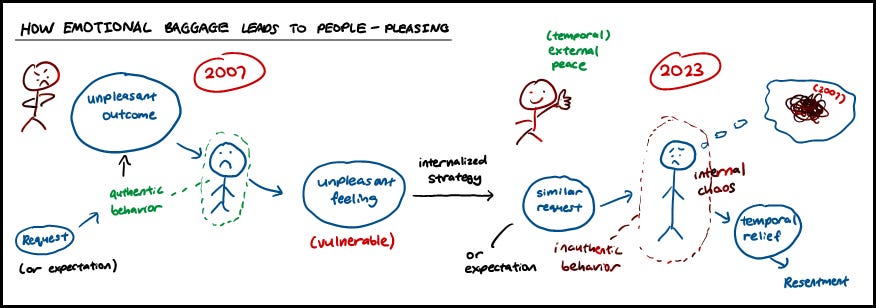
The subconscious mind of a people-pleaser, origins, and dangers
Our people-pleasing habits originate in the complex interplay of upbringing, environmental influences, and self-internalization. We convinced ourselves that our actions are driven by good intentions and our morals, without realizing that this is a façade to altruism (see Table 1). Our interactions are driven by hidden motivations — to fulfil our emotional needs — so we do not have a genuine desire to carry out the requested or expected deed. Consequently, when the expectation of the thing we want in return (e.g. expecting people to acknowledge our efforts, or changing their unwarranted behavior when they take issue with us when things go wrong) does not happen, we wind up in the same place to please even more to try achieve our goals, and eventually, erupting from built-up grievance or collapsing from burnout.

Due to negative associations (e.g. stress responses, disciplinary, exclusion, etc.), or even positive ones (e.g. praising, rewarding, pride, affirmation, etc.) when growing up, our younger-self programmed rules subconsciously to feel worthy or safe as an emotional mechanism, but this made us extremely emotionally reliant on other people, which leaves our identity obscured.
Why people-pleasing affects our mental health
The constant compulsion to cater to others can result in a pervasive sense of anxiety and stress. We will find ourselves in a state of hyper-vigilance; constantly monitoring the reactions of those around us. And because our compulsion to please others arises from a desire to obtain something, these external validations become the source of our self-worth; and we will feel inadequate without it. This makes us insecure, as our sense of worth is contingent on what others impose on us.
In power dynamics, assertive individuals have less regard for our personal limits. When they recognize that a person has a high dependence on external validation, they may use this to subtly manipulate the individual into catering to their needs, knowing that the pleaser’s self-worth is intertwined with the (occasional) validation they receive. As this pattern persists, it creates an exploitative culture where the pleaser is expected to continuously meet the assertive individual's demands, and this can cause the pleaser to suffer from burnout.
Navigating relationships with authenticity
To break free from the cycle of seeking external validation and compromising our well-being, we can start by surrounding ourselves with people who genuinely appreciate and respect us. We need to find a safe space where we can openly express our needs, feelings, and boundaries, without fearing judgment or rejection. If the people around us react negatively or guilt us when we communicate our boundaries, then they don’t value our feelings and it may be time to reconsider their place in our lives.
We have freewill; and we have the right to say no if we are not responsible for it.
Learning to say no gracefully
When we are faced with a request or obligation, we may find ourselves impulsively agreeing, despite the inner hesitation. We need to first recognize that we respond on impulse because we feel pressured. And that indicates unwillingness to take responsibility. What we need to do now is to take a moment to pause, and introspect:
What I’m about to say yes to — Is this an obligation, rule I created / am following, or desire?
Am I doing this to control / influence someone’s perception of me?
Will I still continue with the request if I won’t get acknowledgement / recognition / validation of my competency?
Am I tempted to defer or delegate the responsibility to another person?
Is this genuinely mutually beneficial?
What will saying no to this allow me to say yes to?
Once we have assessed our priorities and hidden motivations, we can make our decision gracefully:
Express gratitude. This shows our appreciation for the person asking.
Be clear and direct. Clearly express our decision without leaving room for misinterpretation.
If you say no, offer alternatives. This shows our willingness to contribute while respecting our boundaries.
Stay firm. If the person is persistent and tries to guilt-trip you, stay firm but polite. If we raise the boundary, we need to uphold it and conform to what we say or want, otherwise we won’t be taken seriously.
It’s time to break the mold we shaped to please others. Being authentic is being intimate, and this allows us to form genuine and happier relationships with people. Natalie Lue's The Joy of Saying No (2022) offers practical insights for breaking the habit of people-pleasing and setting healthier boundaries. By reclaiming our autonomy, we regain control over our lives, have a greater sense of belonging, and confidence.
Endnote
I am deeply grateful for Natalie’s work. She gave me confidence to confront and forgive emotional baggage I had growing up; and guided me to establish healthier boundaries in my interpersonal relationships. My purpose of writing this short article is to spread the word of her book and inspire people to break free from enabling those who doesn’t have our welfare as their priority.
As a recovering people-pleaser, I can't emphasize enough how my life has changed when I started applying the principles in my personalized framework. In Natalie’s book, she delves into greater detail the reasons we please, the 5 people-pleasing types and the 6 steps of finding the joy in saying no. Reading her book felt like a compassionate hand guiding me through a journey of self-discovery and growth.
When I introduced Natalie's book to my friends, some of them were skeptical whether they exhibited people-pleasing tendencies. However, as we delved deeper, it became evident that most of us carry emotional baggage from our past that we avoided or downplayed. Even the best of us gravitate toward situations and play the role of a pleaser without realizing it. The difference lies in the level of awareness and the degree of our people-pleasing.
Reading this book not only help us identify these behaviors within ourselves and others, but also become aware on how to guide future generations toward a more balanced approach to life. The role adults play in teaching kids to be empathetic and understanding, while also recognizing and respecting boundaries should not be underestimated.
Want to connect with me?

Ernest, thank you so so much for your support and sharing my work. I love the diagram! I love this piece. You never know when you’re writing something who it will impact and how.